Description
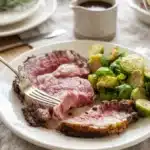
Butter and Garlic Crusted Prime Rib is a tender, juicy, and flavorful holiday roast coated in rich garlic herb butter and served with homemade beef gravy. This oven-roasted prime rib recipe combines a golden-brown garlic butter crust with aromatic rosemary, thyme, and black pepper. Perfect for Christmas dinner, family gatherings, and special occasions, this impressive beef roast makes a delicious centerpiece for your holiday table.
Ingredients
Instructions
- Place the boneless ribeye roast in a roasting pan. Season the entire surface evenly with 2 tablespoons of salt.
- Allow the seasoned roast to stand at room temperature for at least 30 minutes before cooking. Do not leave raw beef at room temperature for more than 2 hours.
- Preheat your oven to 500°F (260°C).
- In a mixing bowl, combine the softened butter, minced garlic, chopped rosemary, chopped thyme, and black pepper. Stir until the ingredients form a smooth, evenly mixed garlic herb butter.
- Spread the garlic herb butter mixture generously over the entire surface of the prime rib roast. Cover the top and sides evenly.
- Place the roasting pan in the preheated oven and roast at 500°F (260°C) for 25 minutes to develop a rich, golden-brown garlic butter crust.
- After 25 minutes, turn off the oven without opening the oven door. Leave the roast inside for approximately 2 hours, allowing the retained heat to continue cooking the beef.
- Begin monitoring the internal temperature after approximately 1 hour using an oven-safe meat thermometer with an external probe. Keep the oven door closed and remove the roast when it reaches your desired temperature. USDA guidance recommends cooking beef roasts to at least 145°F (63°C), followed by a minimum 3-minute rest.
- Transfer the cooked prime rib to a cutting board. Loosely cover it with aluminum foil and allow it to rest for approximately 20 minutes before carving.
- Meanwhile, pour the roasting pan juices into a medium saucepan and warm over medium heat.
- Whisk the all-purpose flour and beef stock into the warm pan juices. Continue stirring until the gravy thickens and becomes smooth.
- Remove the gravy from the heat and strain it to eliminate any lumps.
- Using a sharp carving knife, slice the rested prime rib into even portions. Serve immediately with the warm homemade beef gravy and your favorite Christmas side dishes.
Notes
Use a meat thermometer equipped with an oven-safe external probe to monitor the internal temperature without opening the oven door.
Keep the oven door completely closed after switching off the heat. Opening the door releases heat and can interfere with the cooking process.
Begin checking the internal temperature approximately 1 hour into the residual-heat cooking period to help prevent overcooking.
Rare: 120–125°F (49–52°C), with a bright red center.
Medium-rare: 130–135°F (54–57°C), with a predominantly pink center.
Medium: 140–145°F (60–63°C), with a pink center and browned edges.
Medium-well: 150–155°F (66–68°C), with little to no pink.
Well-done: 160°F (71°C) or higher.
These doneness temperatures describe cooking preferences rather than official food-safety recommendations. USDA guidance recommends cooking beef roasts to a minimum internal temperature of 145°F (63°C), followed by at least 3 minutes of resting.
The roast’s internal temperature may increase approximately 5°F during resting. Account for carryover cooking when monitoring doneness.
Allow the roast to rest loosely covered with aluminum foil for 15–20 minutes before carving to help retain its natural juices.
Use smooth, deliberate knife strokes when carving instead of repeatedly sawing through the meat.
Slice only the amount needed for immediate serving. Keeping the remaining roast whole helps it retain warmth and moisture.
Removing the outer fat before serving is optional.
For dried herb substitutions, replace 2 tablespoons of fresh rosemary with approximately 2 teaspoons of dried rosemary. Replace 2 tablespoons of fresh thyme with approximately 2 teaspoons of dried thyme.
For a bone-in variation, ask your butcher to detach the rib bones and secure them back onto the roast with kitchen twine. Cooking times may vary.
For a smoked variation, preheat a smoker to 225°F (107°C). Place the roast directly on the grate with the bone side facing downward if applicable. Smoke with the lid closed for approximately 35–40 minutes per pound, checking the internal temperature regularly.
Cooking times vary depending on the roast’s size, thickness, starting temperature, and cooking equipment.
Prime rib is also known as standing rib roast or ribeye roast. The term prime rib does not necessarily indicate a USDA Prime quality grade.
Plan approximately 1/2 pound of uncooked boneless roast per person when serving several side dishes. Allow approximately 1 pound per person for larger portions.
Serve with creamy mashed potatoes, roasted carrots, Brussels sprouts, horseradish sauce, or homemade beef gravy.
For food safety, refrigerate leftovers within 2 hours of cooking. Store refrigerated leftovers at 40°F (4°C) or below for 3–4 days.
Freeze leftover prime rib in airtight freezer-safe containers. For the best quality, use within 2–3 months.
Reheat leftovers to an internal temperature of 165°F (74°C).
Required equipment: roasting pan, mixing bowl, oven-safe meat thermometer with external probe, aluminum foil, cutting board, carving knife, medium saucepan, and whisk.
The original recipe lists approximately 466 calories per serving. Additional nutritional information was not provided.